

AI Agent Orchestration: The 3-Lane Chain I Run Daily

AI agent orchestration that holds up in production splits work into three lanes: one agent plans, one agent executes by dispatching specialists, and an independent agent checks the result with the power to reject it. Every handoff carries proof. The check lane is the part most setups skip, and it's the part that makes the rest trustworthy.
I run this exact pattern across a fleet of 40-plus named agents. Not a diagram from a paper. A chain I use every day, and one I've already cut down once.
What is the best way to orchestrate AI agents?
The best way is to give every piece of work one clear owner, separate planning from doing from checking, and require proof at each handoff. Orchestration fails when agents share fuzzy responsibility, and it works when every lane knows exactly what it owns.
In practice that comes down to four rules I run by:
- Routing is the default, not a judgment call. If a named owner exists for the work, the work goes to that owner. Design goes to the design lead. Content goes to the content lead. Security goes to the security lead. My own instruction file says not to do a lead's work directly "because it looks quick."
- Separate the lanes. The agent that plans doesn't grade its own plan. The agent that builds doesn't approve its own build.
- Dispatch in waves when work splits. Run several instances of the same lead on different slices, then reconcile. My rule for it: "one lead exploring six directions at once beats six sequential prompts from a generalist."
- Every handoff carries evidence. Not "done." Done plus the proof.
Everything else is detail. Get those four right and multi-agent work stops feeling like herding cats.
What are the 5 components of an AI agent?
A practical answer: a name, a description, a set of tools, a model, and a system prompt. Those are literally the fields in a Claude Code subagent definition, and they map cleanly onto what every agent needs.
| Component | What it does in orchestration |
|---|---|
| Name | How other agents and the router refer to it |
| Description | What the router reads to decide when to dispatch it |
| Tools | What it is allowed to touch |
| Model | How much reasoning it gets, and what it costs |
| System prompt | Its job, its rules, its definition of done |
Subagent definitions live as Markdown files with YAML frontmatter, in .claude/agents/ at project level or ~/.claude/agents/ at user level. The detail that matters for orchestration: each subagent runs in its own context window, with its own system prompt, its own tool access and its own permissions. Its file reads and tool output don't land in the parent's context. That isolation is what makes fan-out affordable, and it's the subagent layer this coordinates.
Notice two of those five components are about routing. The name and the description exist so something else can decide when to call the agent. That's the tell. An agent isn't just a model with a prompt. It's a model with a prompt that other agents can find.
The three-lane chain: plan, execute, check
Here's the chain I actually run. I will name names, because the names are part of how it works.
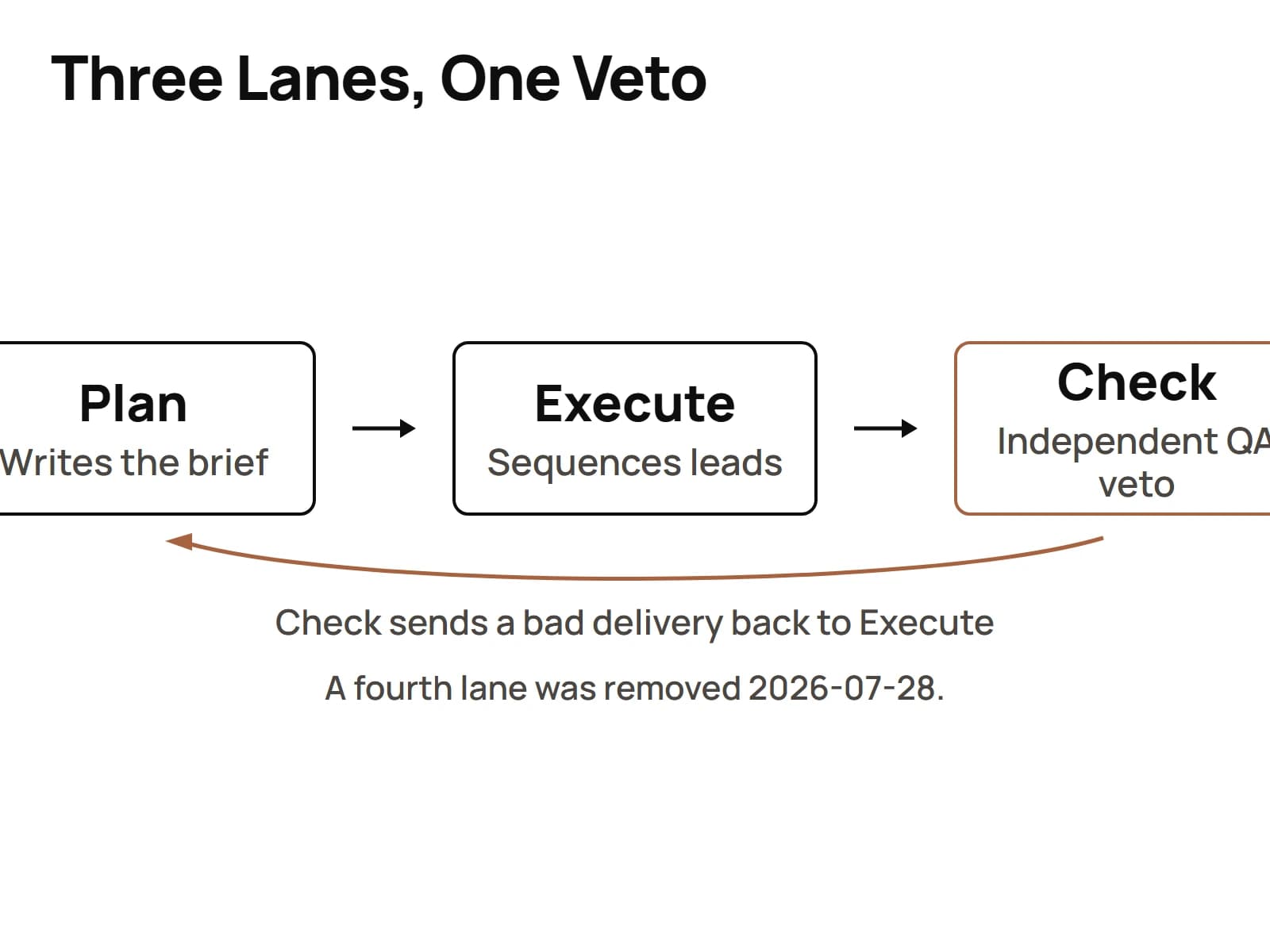
| Lane | Agent | Job |
|---|---|---|
| Plan | Oliver | Understands the intent and writes the scored brief |
| Execute | Carlos | Takes the approved brief, sequences the leads, manages handoffs |
| Check | Queen | Independent QA with veto power over the delivery |
In front of the chain sits an intake identity, my executive assistant, who captures what I asked for and routes it. She doesn't own a lane. She feeds the chain.
I described it once in plain words: "Then Oliver, when done, passes to Carlos, who conducts and takes care of everything, then everybody reports to Queen." That's the whole design in one sentence, and it's the exact chain I run today.
Now the part I want to be straight about. This used to be four lanes. There was a fourth "act" lane with its own improvement machinery on top. On July 28, 2026, I removed it and archived it out of the live tree. Three lanes now. If you see anyone describe my setup with four lanes, that description is stale.
Why three and not two? Because the moment you merge execute and check, you're grading your own homework, right? Nobody fails their own homework. And why not five? Because every extra lane is another handoff, and every handoff is a place for work to get dropped.
What is the best AI agent orchestrator?
The best AI agent orchestrator is the one that enforces clear ownership and an independent check, and that's a pattern before it's a product. I wouldn't pick a tool first and bend the work around it.
In my setup the orchestrator is an agent, not a framework. Oliver writes the plan, Carlos conducts, and the specialists are named leads with their own instruction files. The tooling underneath is layered. My fleet doctrine literally says "AND not OR. Layer tools by strength, never lock into one when combining gives better results."
One concrete example of the pattern beating the product: my Codex lane has a dispatch-first rule. When a named owner exists for the work, the work gets routed to that owner's profile instead of Codex running it directly. Direct Codex use is kept for bounded worker jobs, read-only inspection, or one-shot actions with no dispatch equivalent. Same model, same tool. The rule is what makes it orchestration instead of a free-for-all.
So when you evaluate orchestrators, ask three questions. Can I name the owner of each step? Can a separate agent reject the output? Does every handoff carry proof? A tool that can't answer yes to all three is a task runner, not an orchestrator.
What are the big 4 AI agents?
No official big four exists. The phrase usually points at the agent products from the largest AI labs, and that lineup keeps shifting.
For orchestration the more useful list is the runtimes you coordinate. Mine are Claude Code as the default identity in every terminal, Codex as a second lane, Gemini CLI for search-grounded work and very large context, plus Hermes and OpenClaw as live runtimes. The orchestration layer sits above all of them. The same plan, execute, check chain applies whichever runtime ends up doing the work.
That's the real point. Don't orchestrate a brand. Orchestrate roles, and let the roles run on whatever runtime fits the job.
Why the check lane has to be able to say no
A check lane that can only comment is decoration. It has to be a real QA gate. The whole value of Queen is that she can block a delivery, and the work doesn't reach me until it clears.
Here's why that matters so much. An agent that finished a task is the worst judge of whether the task is done. It has every incentive to report success and every blind spot the builder had. The fleet doctrine every one of my agents carries says to "close loops with validation," and a loop only closes if something outside the builder can fail it.
In practice the check lane looks for:
- Proof, not claims. A screenshot, a test run, a live URL returning a 200, the actual file.
- The original ask. Did the delivery do what was requested, or something adjacent that was easier?
- Evidence it was verified, not assumed. A repair isn't done because an agent says "fixed."
This is how every handoff gets verified in my fleet. Each lead records its own proof of work, because only the lead knows whether the thing it was asked to do actually got done. Queen then checks that proof independently. Two layers of accountability, and neither one trusts the other's word. Verification is the product, not a courtesy.
The payoff is the thing the doctrine is aiming at: less human correction. Every bad delivery Queen stops is a correction I don't have to make myself.
Where orchestration stops paying for itself
Orchestration has a cost, and pretending otherwise is how you end up with a 12-agent pipeline for a typo fix.
My own rules draw the line explicitly. Direct work, no dispatch, is allowed for admin, a question, a one-line fix, a config edit, a doc tweak, or reading and reporting. Anything that produces a client-facing artifact has an owner and goes through the chain. That line saves a ton of pointless handoffs.
The other cost is headcount. What a fleet of named specialists looks like is powerful, but more agents means more lanes to maintain, more instruction files, more handoffs. This is an active question for me right now. Recently I was weighing whether certain roles still earn their seat, and I put it plainly: "even Ted, we have a full 15 workers over there." Another setup in my notes deliberately holds agents at a fixed 12 and gives each one broad mega-blueprints instead of adding more agents.
So here's my honest rule of thumb:
- Orchestrate when the work has multiple domains, a client-facing output, or a real cost of being wrong.
- Go direct when it's small, reversible and one domain.
- Cut a role when its work could be a skill inside another role.
The doctrine behind all of it fits in one line: plan before action, close loops with validation, minimize human intervention, use semantic naming, and layer tools. Orchestration is just the machinery that makes those five principles happen without me babysitting every step. When the machinery costs more than the babysitting it saves, simplify. Cutting lanes is allowed. I've done it.
Questions people actually ask
- What is the best way to orchestrate AI agents?
- Give every piece of work one named owner, separate planning from executing from checking, and require proof at every handoff. Route to the owner by default, split big work into parallel waves of the same lead, and let an independent check lane reject any delivery that can't show evidence.
- What is the best AI agent orchestrator?
- The best orchestrator is a pattern before it's a product: clear ownership of each step, an independent check that can reject output, and proof at every handoff. A tool that can't give you all three is a task runner. In my setup the orchestrator is a named planning agent, not a framework.
- What are the 5 components of an AI agent?
- A practical set is name, description, tools, model and system prompt, which are the fields of a Claude Code subagent definition. The name and description let a router find and dispatch it, tools set what it can touch, the model sets reasoning and cost, and the prompt defines its job.
- What are the big 4 AI agents?
- No official big four exists. People usually mean agent products from the largest AI labs, and the lineup shifts. For orchestration, list the runtimes you coordinate instead. Mine are Claude Code, Codex, Gemini CLI, Hermes and OpenClaw, all under one plan, execute and check chain.