

Claude Code vs Cursor: Which Task Goes Where

Claude Code vs Cursor is really terminal-first agent vs IDE-first editor. Claude Code takes a task, works through your repo from the command line and comes back with the change. Cursor keeps you inside an editor with its own models priced cheaply inside its plan. My production default is Claude Code. Which one fits you depends on how you want to work.
So let me say up front where I stand, because it shapes everything below.
My documented daily stack is terminal-first. Claude Code is the default identity in every terminal I open, Codex runs as a dispatched second lane, and Gemini CLI handles search-grounded and huge-context reads. Cursor isn't one of my production lanes. I'm not going to pretend I've run a controlled head-to-head, and I'm not going to trash a tool plenty of developers choose on purpose.
What I CAN give you is the structural comparison most posts miss, and the routing logic I'd use to decide.
Why do people use the claude code instead of the Cursor?
People pick Claude Code over Cursor mostly because it's agentic and terminal-first: you hand it a whole task instead of steering edits inside an editor. It also runs anywhere a terminal runs, which matters for agents on servers and runtimes with no editor at all. For my fleet, that second reason decides it.
Here are the reasons that are real in my setup:
- It runs where no human is sitting. My agents work across machines and runtimes. A terminal tool goes wherever a shell goes. An editor needs someone in front of it.
- It's built for delegation. Named specialist agents load into Claude Code from generated loader files. That's a fleet pattern, not a solo-coding pattern.
- Subagents keep context clean. A subagent runs in its own context window, so a wide read doesn't flood the main session.
- One vendor, one meter. Every prompt, tool call, file read and thinking block draws from the same plan allowance. Simple to reason about, even when it's tight.
And the flip side: if you want to see and approve every line as it's written, an editor is the better seat. That's a preference, not a flaw.
Does the Claude code use Cursor?
No. Claude Code is Anthropic's own tool and doesn't depend on Cursor in any way. The connection goes the other direction: Cursor can use Claude models. Inside Cursor, third-party models like Claude, GPT and Gemini draw from a separate usage pool charged at each model's API price, as of September 2026.
So there are two very different ways "Claude plus Cursor" can happen:
- Claude models inside Cursor. You pick a Claude model in Cursor's model menu. That usage comes out of Cursor's second pool, the one for third-party models, billed at API rates.
- Claude Code next to Cursor. Claude Code is a terminal tool, so you can run it in whatever terminal you like, including the one inside your editor, while the editor does its own thing. That usage comes out of your Claude plan.
Same model family, two separate bills, two separate meters. Worth knowing before you assume one subscription covers both.
Should I use Claude code with VS Code or Cursor?
Use Claude Code with VS Code if you mainly want a good editor to look at the changes Claude Code makes. Use it with Cursor if you also want Cursor's own AI features and its included model usage. The question is really whether you'll pay for two AI layers or one.
My rule of thumb:
- VS Code plus Claude Code fits when the agent does the heavy lifting and the editor is just where you read diffs. One AI bill.
- Cursor plus Claude Code fits when you like Cursor's in-editor assistance for small edits and want Claude Code for big multi-file jobs. Two AI bills, two meters to watch.
- Cursor alone fits when you want everything inside one editor and you're happy running mostly on Cursor's own models.
None of these is wrong. Just be deliberate. Paying twice for overlapping help is an easy waste to miss, you know, because each bill looks reasonable on its own.
If you're going the Claude Code route, start with the Claude Code fundamentals before you bolt anything else on.
Is the Cursor losing to the claude code?
There's no reliable public data that shows Cursor losing to Claude Code, so I won't claim it either way. What you can see is strategy. Cursor now leans on its own first-party model, Composer 2.5, and its paid plans give its own models significantly more included usage than third-party ones. That looks like a tool building its own lane, not folding. It also has a new owner: SpaceX closed its purchase of Cursor on 2026-08-14, which is why SpaceX's own Grok models sit in that cheaper first-party pool.
Read the structure, as of September 2026:
- Six plans. Hobby (free), Pro ($20/mo), Pro+ ($60/mo), Ultra ($200/mo), Teams ($40/user/mo) and Enterprise (custom). Annual billing saves roughly 20 percent.
- Two usage pools per paid plan, reset monthly. Pool one, which Cursor calls Cursor Models, covers Grok 4.7, Grok 4.6, Grok 4.5 and Composer 2.5, with significantly more included usage. Pool two covers Claude, GPT and Gemini at each model's API price.
- Auto mode isn't unlimited. Since 2026-08-24, every Auto request bills at the list price of the model it gets routed to, so Auto spends from a pool like everything else.
Cursor describes Composer 2.5 as frontier-level coding "at a fraction of the cost of third-party models." That's the vendor's claim. I haven't seen a benchmark I'd stand behind, so I'm not calling it a match for Claude or GPT on code.
The logic is easy to follow, though. A first-party model is the only part of the stack whose margin Cursor fully controls. So the plan design nudges you toward it.
The "losing" framing is a feed-algorithm take. One creator in my saved library, Mark Kashef, frames the Claude-versus-Cursor debate as "two main schools of thought" and advises against letting the algorithm decide for you. Good advice.
How I route a task to one or the other
Here's the decision I'd make, task by task.
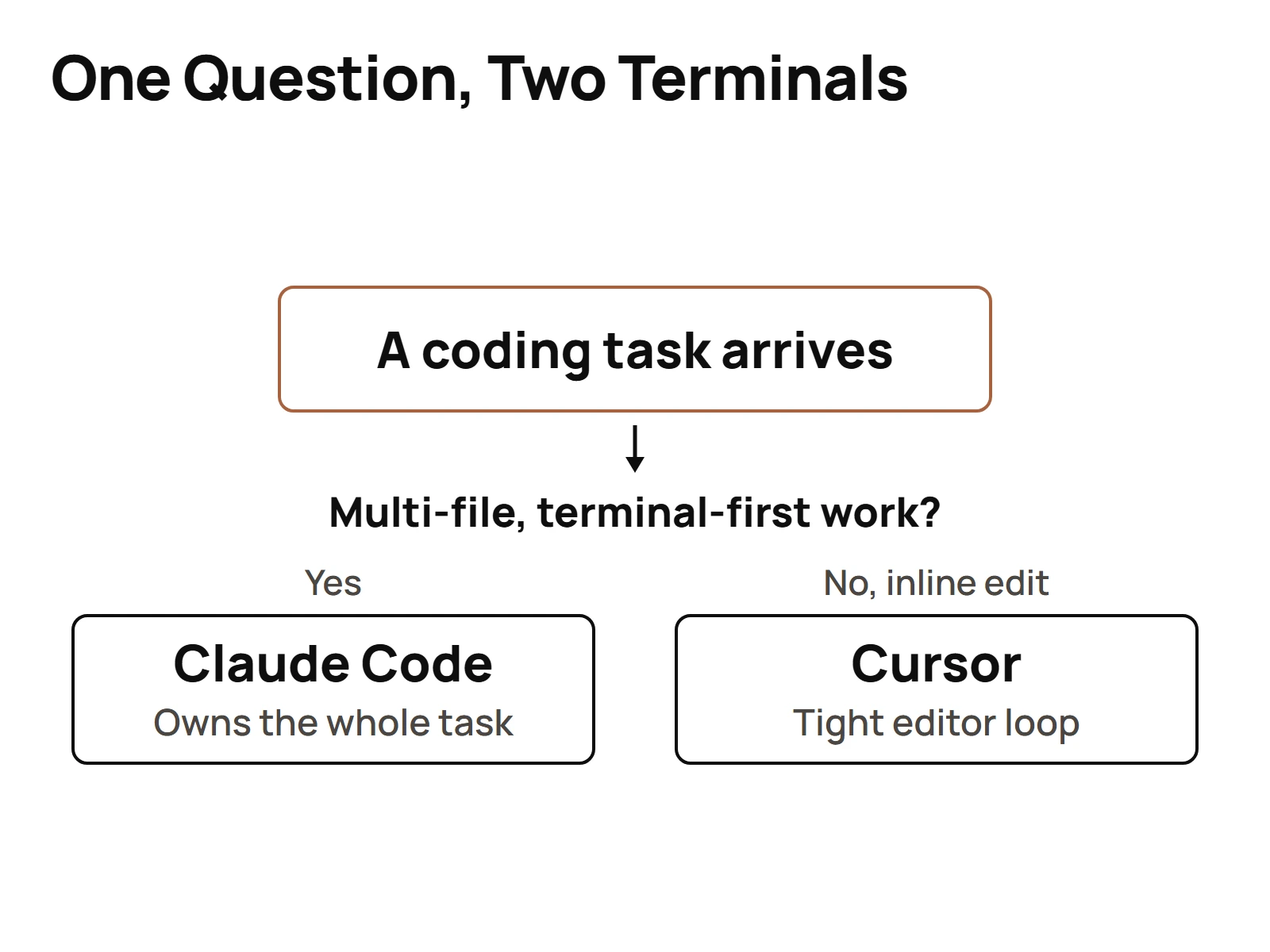
Hand it to Claude Code when:
- the task spans many files and ends with tests passing
- nobody needs to watch it happen
- it has to run on a server or inside an agent runtime
- it's part of a bigger workflow with named agents and handoffs
Open an editor like Cursor when:
- a human wants to steer small edits line by line
- you're exploring unfamiliar code and want answers next to the file
- the job is quick and interactive, not a delegated task
Before you pick, answer four questions honestly:
- Who is doing the work, you or an agent? If an agent, lean terminal-first.
- Where does it run? A server with no desktop rules out an editor.
- How do you want to pay? One allowance across everything, or a split meter that makes the vendor's own models cheap?
- What do you already pay for? Stacking a second AI subscription on top of one you barely use isn't a strategy.
For a fleet, the first list is almost all the work. For a solo developer shipping one app, the second list might be most of the day. That's why "which is better" has no single answer. It's "better for which kind of work."
Running both, and what that costs
Running both means two subscriptions and two very different meters. At entry level, as of September 2026, that's Claude Pro at $20 a month plus Cursor Pro at $20 a month, so about $40 before any overage or upgrade. The bigger cost isn't the sticker. It's not knowing which meter you're burning.
Here's how the two meters behave:
| Claude Code | Cursor | |
|---|---|---|
| Entry paid plan | Pro, $20/mo | Pro, $20/mo (about $16 annual) |
| Higher tiers | Max 5x $100/mo, Max 20x $200/mo | Pro+ $60/mo, Ultra $200/mo |
| How usage is metered | One allowance for everything, on a five-hour session limit and a weekly limit at the same time | Two pools: Cursor's own models, and third-party models at API price |
| Published token limit | None. Run /usage in Claude Code, or check Settings, then Usage, on claude.ai | Included usage per pool, reset monthly |
Two things I'd watch if I were running both:
Claude Code's two meters overlap. You can be inside your five-hour window and still be blocked by the weekly cap. And Anthropic publishes no token count for any plan, so any post quoting an exact number is guessing.
Claude inside Cursor is billed by Cursor. If you pick Claude models in Cursor, that usage comes from Cursor's third-party pool at API price, not from your Claude plan. Run both and you might be paying for Claude twice without noticing.
My take? Pick a primary. Mine is Claude Code, because my work is delegated, multi-agent and runs where no editor lives. If yours is hands-on editing all day, Cursor may be your primary, and that's a legit call. Then add the second tool only where it earns its bill. That's the whole trick, and it saves more money than any coupon ever will.
Questions people actually ask
- Is the Cursor losing to the claude code?
- There's no reliable public data that shows Cursor losing to Claude Code, so I won't claim it either way. What you can see is strategy. Cursor now leans on its own first-party model, Composer 2.5, and its paid plans give its own models significantly more included usage than third-party ones. That looks like a tool building its own lane, not folding. It also has a new owner: SpaceX closed its purchase of Cursor on 2026-08-14, which is why SpaceX's own Grok models sit in that cheaper first-party pool.
- Should I use Claude code with VS Code or Cursor?
- Use Claude Code with VS Code if you mainly want a good editor to look at the changes Claude Code makes. Use it with Cursor if you also want Cursor's own AI features and its included model usage. The question is really whether you'll pay for two AI layers or one.
- Why do people use the claude code instead of the Cursor?
- People pick Claude Code over Cursor mostly because it's agentic and terminal-first: you hand it a whole task instead of steering edits inside an editor. It also runs anywhere a terminal runs, which matters for agents on servers and runtimes with no editor at all. For my fleet, that second reason decides it.
- Does the Claude code use Cursor?
- No. Claude Code is Anthropic's own tool and doesn't depend on Cursor in any way. The connection goes the other direction: Cursor can use Claude models. Inside Cursor, third-party models like Claude, GPT and Gemini draw from a separate usage pool charged at each model's API price, as of September 2026.