

What GPT-6 Astra Can Do, and How I'd Test It

GPT-6 Astra is OpenAI's newest frontier model, released as a limited preview on 2026-09-03 and to paid ChatGPT users the next day. OpenAI says it's faster, handles more tasks and finishes multi-step work better than any model before it. It's also the first model OpenAI rated as crossing its "critical" cybersecurity threshold, so it shipped restricted.
That last part is the real story. Everybody is going to write the feature list. The vendor itself flagged this model as crossing a safety line no earlier OpenAI model crossed, and then shipped it with guardrails on. That tells you more about what it can do than any launch video.
Quick note on timing before we go further. As I write this in late September 2026, Astra is only a few weeks old. Everything below is dated, and you should re-check it before you act on it.
How good is GPT-6 Astra?
By OpenAI's own account, very good: the company says it "is faster and capable of performing more tasks than any prior iteration," and calls it a "generational leap" for cybersecurity, professional work, software engineering and science. Independent, long-run verdicts don't exist yet, because the model is only weeks old. Treat every claim, including OpenAI's, as early.
Here's what OpenAI says it improved:
- staying focused on the task
- sticking to task boundaries
- understanding what the user actually meant
- grinding through tedious work
- finishing multi-step workflows
Read that list as an agent operator and it's basically a wishlist. Focus, boundaries and multi-step completion are exactly where agents fall apart in real work. If Astra delivers on those, it matters.
The strongest signal, though, is the safety rating. Under OpenAI's preparedness framework, Astra is the first model designated as reaching the "critical" cybersecurity threshold. OpenAI's stated meaning: it can potentially find and exploit previously unknown vulnerabilities across well-protected systems without step-by-step human guidance. OpenAI also described it as its most aligned model yet.
So how good is it? Good enough that its own maker put a fence around it. That's not marketing. That's a judgment call with a cost attached.
When can I use GPT-6 Astra?
You can use GPT-6 Astra now if you pay. OpenAI released it as a limited preview on 2026-09-03, then publicly released it to paid users on 2026-09-04 in a restricted version that rejects certain prompts, notably in cybersecurity. It's available on ChatGPT Plus, Pro, Business and Enterprise, plus the OpenAI API and Amazon Web Services. The rollout was staggered, though: OpenAI said Pro, Enterprise and Business Premium users and the API got it first, and that Plus and Business users could wait a few more days.
The access map, as of September 2026:
| Where | Available? |
|---|---|
| ChatGPT Plus | Yes |
| ChatGPT Pro | Yes |
| ChatGPT Business | Yes |
| ChatGPT Enterprise | Yes |
| OpenAI API | Yes |
| Amazon Web Services | Yes |
| Free ChatGPT | Not listed at release, which went to paid users |
For anyone building agents, the API and AWS lines are the ones that matter. That's how a model goes from "cool chatbot" to "a lane in your stack."
One practical warning. Because the public version is restricted, what you get may not match every demo you see online. Test your own prompts on your own tier before you plan around it, especially anything that touches security.
Is GPT-6 Astra AGI?
No, not by any established definition, and OpenAI has not formally declared it AGI. OpenAI's president floated the AGI label at launch and left users to decide. That's an executive's opinion, quoted in coverage of the launch. It's not a finding, and it's not a benchmark.
I'm careful here for a reason. "Is it AGI" is a great headline and a terrible buying question. It doesn't change what the model does on Tuesday morning when you hand it a real task.
What IS on the record is more useful. OpenAI rated Astra as crossing its critical cybersecurity threshold, and shipped it restricted. Whatever you want to call that level of capability, the vendor treated it as serious enough to limit. That's the fact I'd plan around. The AGI label is a debate.
What it does well on the tasks I actually run
My fleet has a documented routing policy. Here's where a new frontier model gets tested inside it.
Here's how my worker agents get their model today, in the Claude lane:
| Tier | What it handles |
|---|---|
| Opus | Complex reasoning, architecture, strategy, security. The default for important work |
| Sonnet | Standard analysis, content writing, routine tasks |
| Haiku | Simple lookups, data extraction, formatting, one-off transforms |
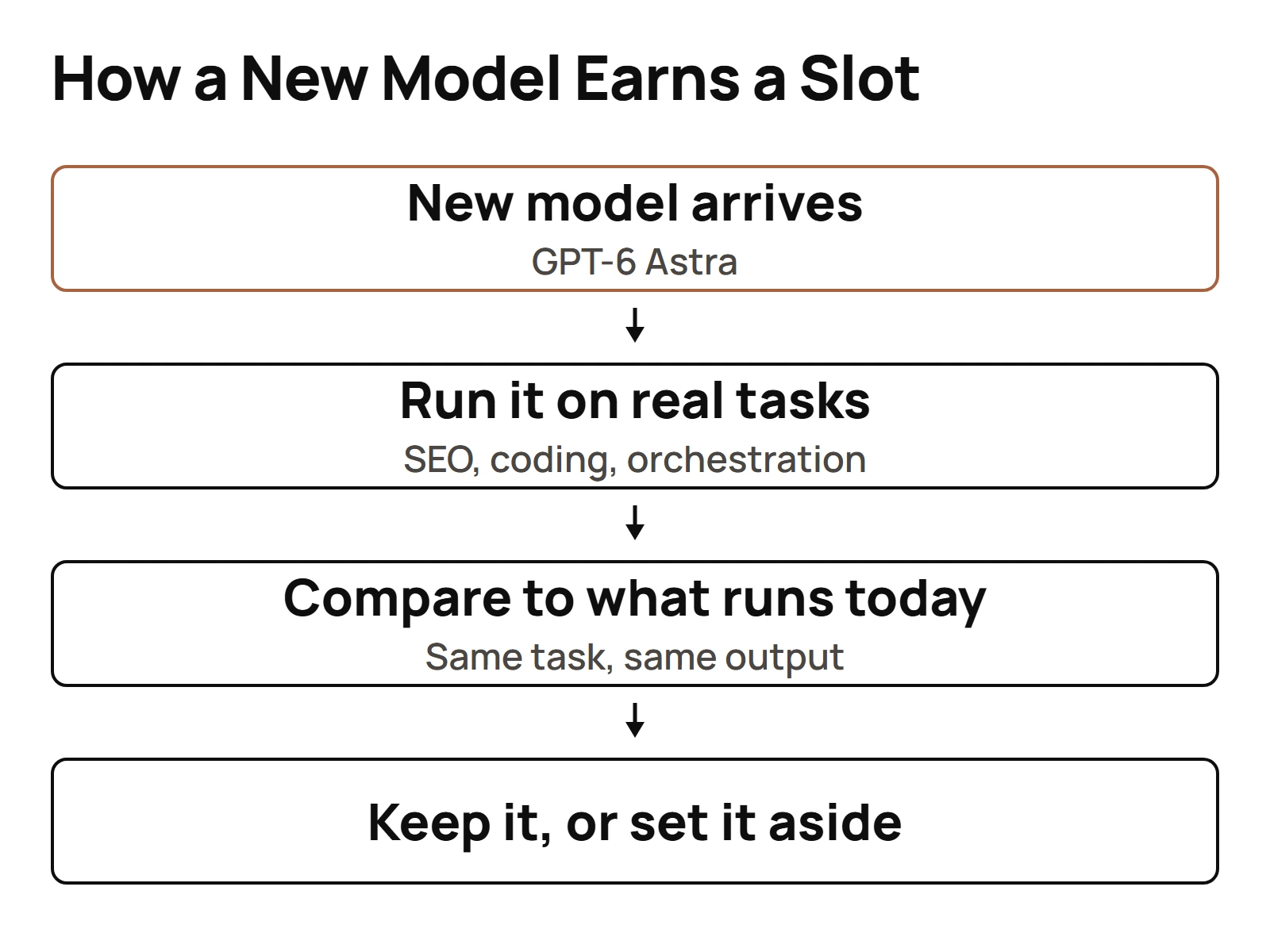
A model pitched as a frontier leap competes for the top row. That's where I'd test Astra first, on the kind of work my fleet runs every day:
- SEO strategy and content planning. Does it hold a long brief together without drifting?
- Coding. Does it finish a multi-file change and stop at the edge of the task, the way OpenAI says it does?
- Orchestration. Does it respect boundaries when it's one agent among many, or does it wander into another lane's work?
Those three are where OpenAI's claimed improvements, focus, boundaries and multi-step completion, would actually show up. That's the test. The result isn't in yet, and I won't pretend it is.
One thing I can already see on paper: the restriction. A version that rejects certain cybersecurity prompts is a real consideration for any security-focused lane. In my routing, security sits in the top tier. So the refusal behavior would be the very first thing I checked before a model like this got anywhere near that work.
Why pay $20 for ChatGPT?
The case for a paid ChatGPT plan right now is access: GPT-6 Astra went to paid users, starting with Plus, and wasn't listed for free users at release. If you want the newest OpenAI model, you pay. ChatGPT Plus is still $20 a month, and Astra use counts against the existing Plus limits, per BleepingComputer on 2026-09-06. Check OpenAI's pricing page before you buy, because that can change.
For context, $20 a month is where a lot of AI tools start their paid tier as of September 2026. Claude Pro is $20 a month. Cursor Pro is $20 a month. So the question isn't really "why pay $20." It's which $20 gets you the most for the work you actually do, you know?
My answer to that has never been one subscription. It's routing. You pay for the tool that wins a given job, and you stop paying for overlap. I laid that out in the full comparison, including what each option costs.
Where it would and wouldn't replace what I run today
My documented rule is to layer tools, not swap them. So Astra doesn't get to replace anything by default. It gets to try out for a lane.
Where it would have a shot:
- the top-tier reasoning slot, if it holds focus on long multi-step work as claimed
- a second opinion on hard architecture calls, next to what already runs there
- API-driven agent work, since it's available through the OpenAI API and AWS
Where it wouldn't replace anything soon:
- Security work, until I know exactly which prompts the restricted version refuses
- My default terminal lane. Claude Code is the identity in every terminal I open, and a brand-new model doesn't unseat a whole workflow in a few weeks
- Anything that depends on stable pricing and behavior. A model this new will change. I wait for it to settle before I build process on top of it
Honestly? I'm excited about this one. A frontier model whose maker says it stays inside task boundaries better is exactly what a multi-agent fleet wants. But excited isn't the same as proven. It earns a lane the same way everything else in my stack did: by winning real work, on the record, against what already runs there.
Questions people actually ask
- How good is GPT-6 Astra?
- By OpenAI's own account, very good: the company says it "is faster and capable of performing more tasks than any prior iteration," and calls it a "generational leap" for cybersecurity, professional work, software engineering and science. Independent, long-run verdicts don't exist yet, because the model is only weeks old. Treat every claim, including OpenAI's, as early.
- When can I use GPT-6 Astra?
- You can use GPT-6 Astra now if you pay. OpenAI released it as a limited preview on 2026-09-03, then publicly released it to paid users on 2026-09-04 in a restricted version that rejects certain prompts, notably in cybersecurity. It's available on ChatGPT Plus, Pro, Business and Enterprise, plus the OpenAI API and Amazon Web Services. The rollout was staggered, though: OpenAI said Pro, Enterprise and Business Premium users and the API got it first, and that Plus and Business users could wait a few more days.
- Why pay $20 for ChatGPT?
- The case for a paid ChatGPT plan right now is access: GPT-6 Astra went to paid users, starting with Plus, and wasn't listed for free users at release. If you want the newest OpenAI model, you pay. ChatGPT Plus is still $20 a month, and Astra use counts against the existing Plus limits, per BleepingComputer on 2026-09-06. Check OpenAI's pricing page before you buy, because that can change.
- Is GPT-6 Astra AGI?
- No, not by any established definition, and OpenAI has not formally declared it AGI. OpenAI's president floated the AGI label at launch and left users to decide. That's an executive's opinion, quoted in coverage of the launch. It's not a finding, and it's not a benchmark.