

Grok AI Review 2026: The 200K Price Cliff Agents Hit

Grok is the AI model family from SpaceXAI, the company formerly called xAI and now part of SpaceX, and as of 2026-09-23 the flagship is Grok 4.7, released 2026-09-21 with the same 500K-token context window and API price as Grok 4.6, which shipped on 2026-08-12. It's positioned for long-running agents, coding, research and visual work. Is it good? It's a serious option on paper. There's no Grok 5 yet, and there's a pricing cliff most reviews never mention.
Let me set the frame, because this isn't a consumer chatbot rating.
I run a fleet of specialist agents. My documented daily stack is Claude Code as the default in every terminal, Codex as a dispatched second lane and Gemini CLI for search-grounded and huge-context work. Grok isn't one of those lanes today. So this review asks the question I actually care about: where would Grok fit in a real multi-agent production stack, and where would it bite you?
Is Grok AI actually good?
Grok AI is a credible frontier option in September 2026. Grok 4.7 is the flagship, released on 2026-09-21 by SpaceXAI (formerly xAI), keeping Grok 4.6's 500K-token context window and its focus on long-running agents, coding, research and interactive or visual work. Whether it's good for YOU depends on the job. I haven't seen an independent benchmark I'd stand behind, so I won't rank it.
What I can say from the spec sheet:
- The context window is big. 500K tokens is a lot of room for long agent sessions and large documents.
- The positioning is agent-friendly. Long-running agents and coding are named focus areas, not afterthoughts.
- There's a coding-specific model. Grok Build 0.1 is listed separately, at a lower price than the flagship.
- The lineup is wide. Grok 4.7, Grok 4.6, Grok 4.5, Grok Build 0.1, plus budget Grok 4.3 and Grok 4.20 variants.
That's a real lineup, not a toy. But "good" for an agent operator means three things: does it finish the task, what does it really cost, and does it behave predictably at scale. The spec sheet answers none of them on its own.
Is there a Grok 5? What actually shipped, as of September 2026
No. As of September 2026 there's no Grok 5. The current flagship is Grok 4.7, released 2026-09-21, one step after Grok 4.6 on 2026-08-12. xAI's own API pricing page, read on 2026-09-23, lists the whole lineup, and there's no Grok 5 on it. If you landed here searching for a Grok 5 review, that's the answer.
I'm calling this out because people are searching for it. A lot. And every page chasing that search is either silent or guessing.
Here's what actually exists right now:
| Model | What it is |
|---|---|
| Grok 4.7 | Flagship, released 2026-09-21, 500K-token context window, same API price as 4.6 |
| Grok 4.6 | Previous flagship, released 2026-08-12, 500K-token context window |
| Grok 4.5 | Still listed, with a cheaper cached-input rate than 4.6 |
| Grok Build 0.1 | Coding-specific model, the cheapest for code workloads |
| Grok 4.3 and Grok 4.20 variants | Budget tier |
Could a Grok 5 ship later? Sure, these things move fast. But reviewing a model that has not shipped would just be making things up, and I'm not doing that. When it exists, it gets judged like everything else: on real work.
Is Grok actually better than chatgpt?
There's no clean yes or no. No benchmark I trust puts Grok 4.7 cleanly ahead of or behind ChatGPT's current models, and "better" changes with the task. What you can compare is structure: Grok 4.7 offers a 500K-token window, while OpenAI just shipped GPT-6 Astra in September 2026 in a restricted version.
Here's how I'd actually think about it:
- For long single sessions with lots of material, Grok 4.7's 500K window is a real advantage worth testing, and the cheaper Grok 4.3 and 4.20 tiers list a 1M window.
- For the newest OpenAI capabilities, GPT-6 Astra went to paid ChatGPT users on 2026-09-04, and OpenAI itself rated it as crossing its critical cybersecurity threshold. Brand new, and deliberately fenced.
- For cost-sensitive coding at volume, Grok Build 0.1's API rate is hard to ignore.
The question I'd rather you ask: better at WHAT, and at what price? That's how I pick every tool in my stack.
How much is Grok AI per month?
It depends on how you use it. For developers and agents, Grok is billed per token through the API: as of 2026-09-23, Grok 4.7 and Grok 4.6 both cost $2.00 per million input tokens and $6.00 per million output tokens for prompts under 200K. I didn't verify xAI's consumer subscription prices for this review, so check xAI's own page for those.
The API rates, read from xAI's own pricing page on 2026-09-23, where they match the September 2026 pricing roundups:
| Model | Input | Cached input | Output |
|---|---|---|---|
| Grok 4.7 or 4.6, prompt under 200K | $2.00/M | $0.50/M | $6.00/M |
| Grok 4.7 or 4.6, prompt at or over 200K | $4.00/M | $1.00/M | $12.00/M |
| Grok 4.5 | $2.00/M | $0.30/M | $6.00/M |
| Grok Build 0.1 | $1.00/M | $0.20/M | $2.00/M |
| Grok 4.3 and 4.20 variants | $1.25/M | $0.20/M | $2.50/M |
There's also a sneaky third option. Cursor's paid plans, as of 2026-09-23, put Grok 4.7, Grok 4.6 and Grok 4.5 in the same usage pool as Cursor's own Composer 2.5, the pool that carries significantly more included usage. That's less strange than it sounds: SpaceX, which owns Grok's maker, closed its purchase of Cursor on 2026-08-14. Cursor Pro is $20 a month. So if you already live in Cursor, you may be able to try Grok without opening a separate xAI account at all.
Prices in this space move constantly. Every number above is dated September 2026. Re-check before you budget.
The 200K rebilling cliff, and why it surprises agent operators
This is the detail that makes this review worth reading.
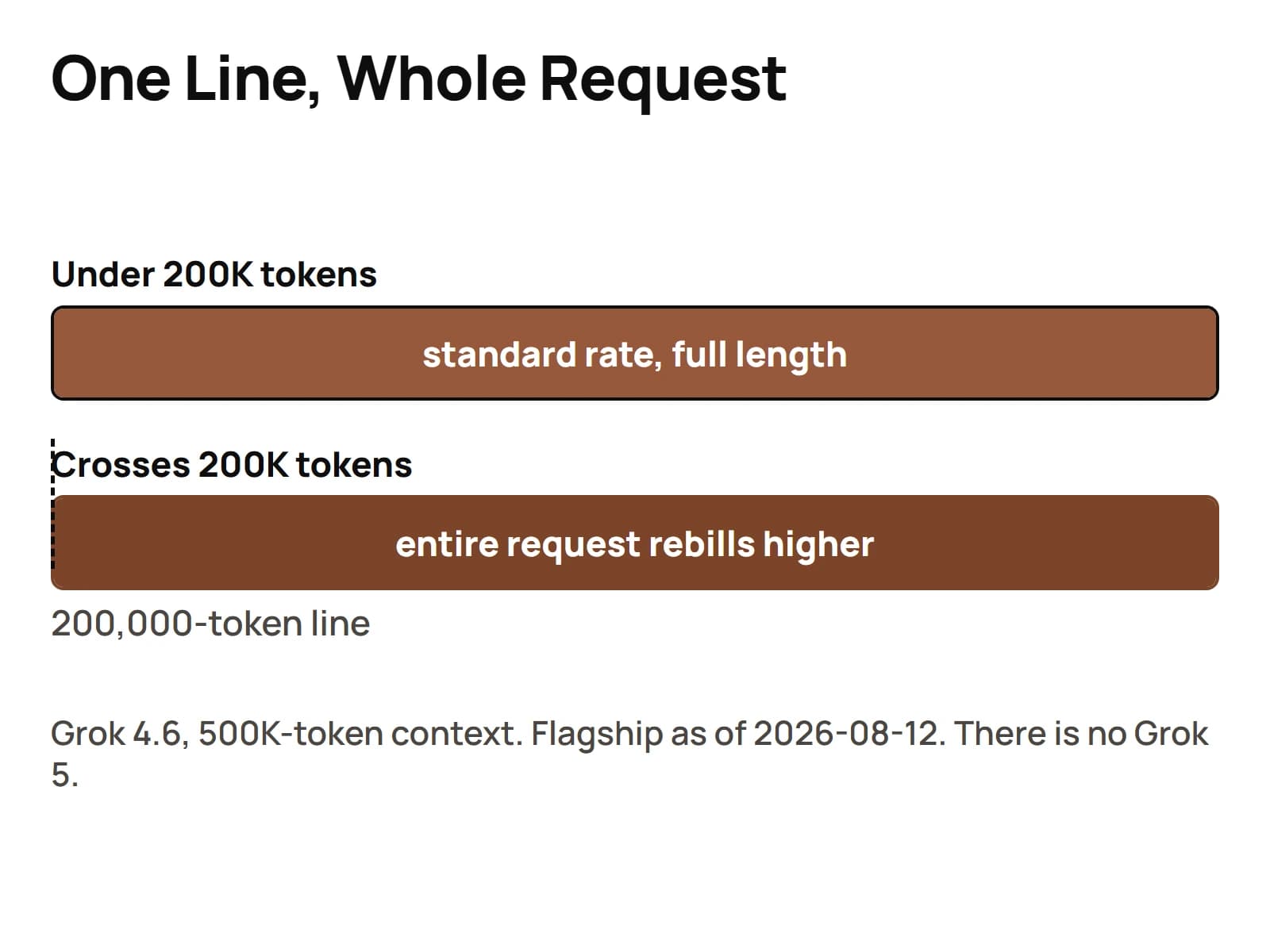
When a Grok 4.7 or 4.6 prompt reaches 200K tokens, xAI doesn't just charge the extra tokens at the higher rate. xAI's pricing page applies the same 200K rule to every model it lists. It rebills the entire request at the higher tier. Input, cached input and output all double.
Here's what that looks like in plain math, using the published September 2026 rates and a request with 10K tokens of output:
| Prompt size | Input cost | Output cost | Total |
|---|---|---|---|
| 199K tokens | $0.398 | $0.060 | $0.458 |
| 201K tokens | $0.804 | $0.120 | $0.924 |
Two thousand more prompt tokens. Roughly double the bill. For ONE request.
Now picture an agent. Agents don't send one request. They loop. Every turn, the context grows: tool output, file reads, earlier messages. A long-running agent that sits comfortably at 190K can drift past 200K without anybody deciding it should, and from that turn on, every call costs about twice as much.
The request doesn't fail. The agent just keeps working, right? The bill is where you find out.
And this is exactly the model pitched for long-running agents, with a 500K window that invites you to use it. The room is there. The price of using it isn't linear.
If I put Grok into a lane, three rules go in with it:
- Cap the prompt below 200K unless the job truly needs more.
- Trim and summarize context between turns instead of letting it pile up.
- Watch cached input. Cached rates are lower, and Grok 4.5 has a cheaper cached rate than 4.6 and 4.7, which matters for agents that resend the same prefix every turn.
This is the same discipline I apply everywhere. Keep the window lean, verify the cache, and never assume price scales in a straight line.
Is Grok AI a trusted app?
Trust depends on what you plan to send it, and that's a call you make after reading the data and privacy terms from SpaceXAI, the company formerly called xAI. I haven't done a security review of Grok, and I don't publish security verdicts about a named product without the vendor's own documentation in front of me. That goes for every AI tool, not just this one.
My practical rule for any AI tool, Grok included:
- Read the vendor's data policy before sending anything sensitive.
- Never paste client secrets, credentials or private customer data into a tool you haven't reviewed.
- Keep keys in environment variables, never in prompts or shared config files.
- Start with low-risk work, public research or throwaway code, and expand only after you're comfortable.
That's not a knock on Grok. It's how every new tool earns its way into my stack.
Where Grok would slot into a production agent stack
Here's where I'd try it, and where I wouldn't, if Grok earned a lane.
Where it could earn a spot:
- Cheap, high-volume coding work. Grok Build 0.1 at $1.00 per million input tokens is aggressive for a coding-specific model.
- Long-context agent sessions, as long as the 200K cliff is managed on purpose.
- Budget batch jobs, where the Grok 4.3 and 4.20 tiers keep costs down.
Where it wouldn't replace what I run:
- My default terminal lane. Claude Code is the identity every terminal opens to. A new model doesn't unseat a whole workflow.
- Search-grounded work. Gemini CLI already owns that lane in my stack, with real-time Google Search grounding.
- Any job where I can't predict cost. Until the rebilling cliff is guarded in code, no long-running agent of mine touches it unsupervised.
The bigger picture is simple. Grok is a real option with a wide lineup, a big context window and one pricing trap that will surprise anyone running agents at scale. Test it on real tasks, guard the cliff, and see how it stacks up against the rest before you commit a lane to it. I'm honestly curious to see what xAI ships next. When a Grok 5 is real, it gets the same test.
Questions people actually ask
- Is Grok AI actually good?
- Grok AI is a credible frontier option in September 2026. Grok 4.7 is the flagship, released on 2026-09-21 by SpaceXAI (formerly xAI), keeping Grok 4.6's 500K-token context window and its focus on long-running agents, coding, research and interactive or visual work. Whether it's good for YOU depends on the job. I haven't seen an independent benchmark I'd stand behind, so I won't rank it.
- Is Grok actually better than chatgpt?
- There's no clean yes or no. No benchmark I trust puts Grok 4.7 cleanly ahead of or behind ChatGPT's current models, and "better" changes with the task. What you can compare is structure: Grok 4.7 offers a 500K-token window, while OpenAI just shipped GPT-6 Astra in September 2026 in a restricted version.
- How much is Grok AI per month?
- It depends on how you use it. For developers and agents, Grok is billed per token through the API: as of 2026-09-23, Grok 4.7 and Grok 4.6 both cost $2.00 per million input tokens and $6.00 per million output tokens for prompts under 200K. I didn't verify xAI's consumer subscription prices for this review, so check xAI's own page for those.
- Is Grok AI a trusted app?
- Trust depends on what you plan to send it, and that's a call you make after reading the data and privacy terms from SpaceXAI, the company formerly called xAI. I haven't done a security review of Grok, and I don't publish security verdicts about a named product without the vendor's own documentation in front of me. That goes for every AI tool, not just this one.