

DeepSeek Local Setup: Running V4 Inside an Agent Harness

Yes, DeepSeek can run locally, but which DeepSeek matters more than anything else. The small and distilled builds run on consumer hardware once you quantize them. The full frontier models need multi-GPU clusters. DeepSeek V4 ships as MIT-licensed open weights, so self-hosting is allowed, and once the weights are on your machine it runs offline.
The more useful question isn't "can I install it." It's where a local model actually earns a slot in an agent harness, next to the paid models you already run. That's what this guide is built around.
Can DeepSeek be run locally?
Yes. The practical version is a smaller or distilled DeepSeek model, quantized to fit your hardware and served by a local runtime. The full-size model is a different story, and the next sections cover why.
A few real reference points from my own library and setup:
- Small builds exist and are genuinely small. A Nate Herk walkthrough in my library lists open-source DeepSeek sizes of 1.5B, 7B and 8B parameters, and he calls them "pretty tiny" next to frontier scale. His framing, not my testing, but it's the right expectation to set.
- Quantization is what makes it fit. A local model config captured on my own machine lists a DeepSeek R1 build at
Q4_K_M, 4 bits per weight. That 4-bit build is the difference between "fits" and "does not fit" on consumer hardware. - A full local stack is a known pattern. A DevsKingdom video in my library builds a local replica of DeepSeek chat from four parts: a distilled DeepSeek-R1-Distill-Qwen-32B model, vLLM to serve it, OpenWebUI as the interface, and SearXNG for search. That's their build. It's a clean map of the pieces you need.
So yes, run it locally. Just know that the "DeepSeek" on your laptop is a much smaller animal than the one in the headlines.
Can DeepSeek-V4 be self-hosted?
Yes. DeepSeek V4 shipped on April 24, 2026, under the MIT License, as open weights. MIT is permissive: download it, self-host it and run it commercially, no usage tier, no gate.
What you actually get is a two-model, text-only family with a 1M-token context window, sized for very different hardware:
| Variant | Size | Who it is for |
|---|---|---|
| V4-Flash | 284B total parameters, 13B active | The tier that can realistically be self-hosted |
| V4-Pro | 1.6T total parameters, 49B active | Cluster territory |
DeepSeek's own V4 announcement puts V4-Pro at 1.6T total parameters with 49B active, which is why it sits in cluster territory. Same reason there are no benchmark scores in this article: I didn't find one I'd stand behind.
Date check, because this field ships quarterly. V4 first shipped as a preview about five months before I wrote this. Since then DeepSeek made V4-Flash official on 2026-07-31, took V4-Pro to general availability on 2026-08-13 and released a multimodal V4.1-Flash on 2026-09-10, so check what's current before you plan around it.
What happened to DeepSeek R2, and what shipped instead
As far as I can find, DeepSeek R2 didn't ship. People search for it a lot, but I found no evidence of an R2 release. The confirmed 2026 flagship is DeepSeek V4.
This matters because there are posts out there "reviewing" R2. You can't review a model that doesn't exist. If you came here looking for R2: it's not a real product as of September 2026, V4 is, and everything in this guide applies to V4 and the smaller DeepSeek builds you can actually download.
If R2 does ship later, the setup pattern below won't change much. The harness doesn't care what the model is called. It cares what it can do and what it needs to run.
Can you run DeepSeek offline?
Yes. Once the weights are downloaded and a local runtime is serving them, inference happens on your own machine and needs no internet connection. That's the whole point of a local LLM.
Two catches. First, the setup isn't offline: you need a connection to download the weights and the runtime in the first place. Second, if you add web search to the stack, like SearXNG in that four-part build, that piece obviously needs a network.
And don't confuse local with "open-weight model through an API." My OpenRouter lane gives me DeepSeek R1 through one key, with a model ID like deepseek/deepseek-r1, and zero hardware. It's great. It's also not offline, because every call goes out to the network. Different tool, different job.
The hardware floor, stated plainly, before you plan around it
Here's the sentence every "run DeepSeek on your laptop" post blurs: free MIT weights and runs-on-your-machine are two completely different claims.
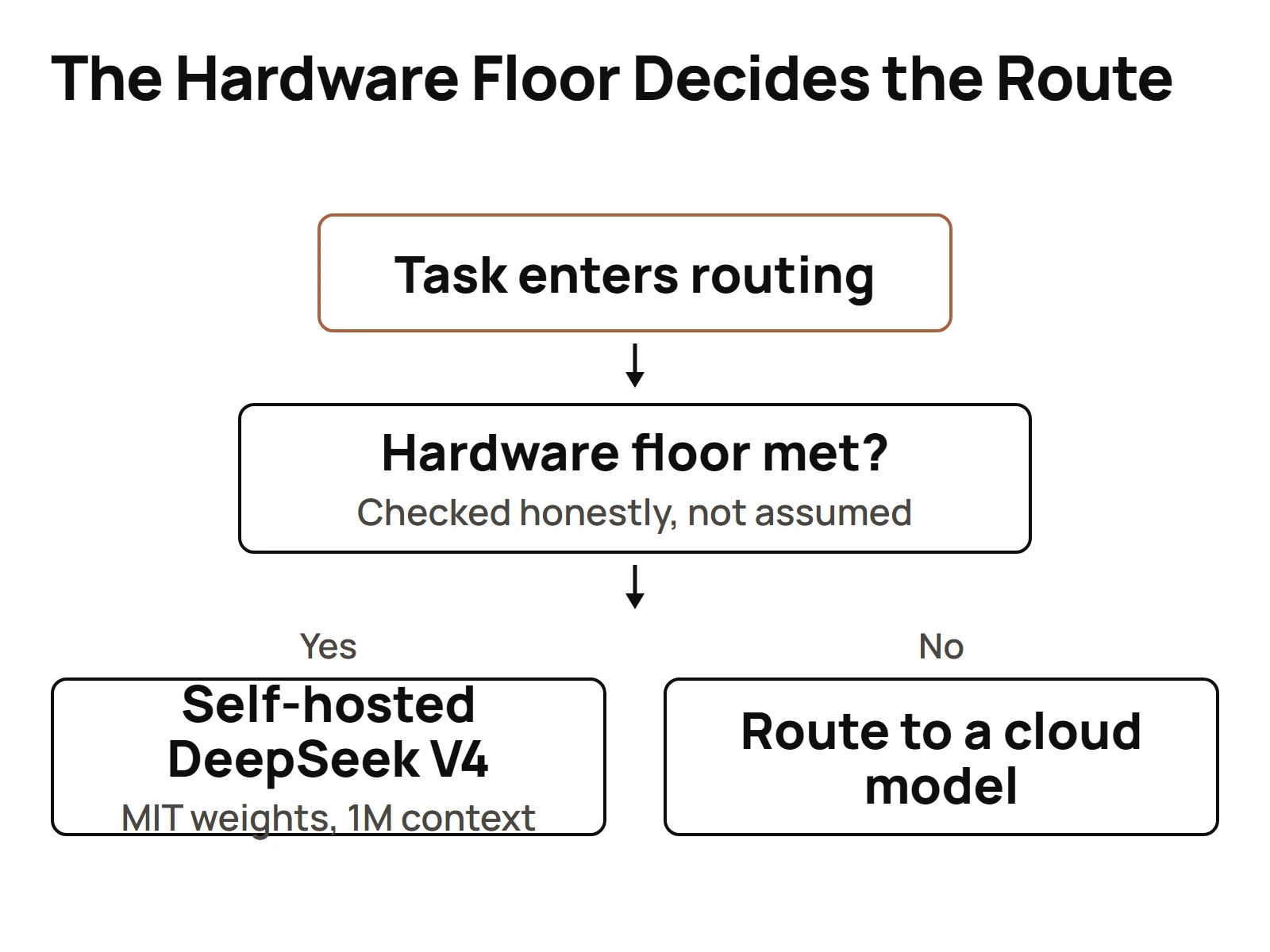
The picture as of September 2026:
- The frontier open models need a cluster. The largest Kimi, DeepSeek and GLM builds lead on raw capability, but with several trillion parameters they need multi-GPU clusters to self-host.
- The distilled or flash tier is the interesting one. The sources I trust say DeepSeek V4-Flash and Mistral Small 4 bring near-frontier quality to 2-GPU setups.
- Nobody in my research chain tested that 2-GPU claim. It comes from roundups, not a benchmark I ran. Treat it as the place to start testing, not a guarantee.
- Small quantized builds are the consumer tier. 4-bit quantization like
Q4_K_Mis what puts a model on normal hardware at all.
Plan from the bottom up. Start with the smallest build that might do the job, test it on real tasks, and only move up the ladder when it fails.
Is running DeepSeek locally safe?
Running it locally is one of the safer ways to use it, because your prompts and data never leave your machine. The risks that remain are the normal ones for any self-hosted model: where you got the weights, how well you maintain the runtime, and whether you check the output.
My practical checklist:
- Get the weights from the official source. Not a random mirror.
- Read the license. V4 is MIT. Not every open-weight model ships under an MIT license or anything that permissive.
- Treat the runtime as software you own. It needs updates and someone watching it, same as any agent runtime. Runtimes drift.
- Keep the output under review. A local model can be confidently wrong, same as a hosted one. Local doesn't mean verified.
- Use local on purpose for private work. This is where local shines. My routing framework has a privacy gate that overrides cost and quality: sensitive work "never leaves the machine."
That fifth point is the real safety win. If you have client data you don't want on anyone's API, a self-hosted model isn't a compromise. It's the requirement.
Wiring it into an agent harness, not just a chat window
A chat window is a demo. A harness is where a model becomes useful: it can call tools, read files, follow a workflow and hand results to the next step.
The pieces you need:
- A server for the model. vLLM in the DevsKingdom build, or whatever local runner you prefer.
- An agent runtime with provider lanes. In my fleet, Hermes runs on profiles, and a profile can point at a primary provider with a configured fallback. That's exactly where a local model plugs in: as one lane among several.
- A routing layer. Something that decides which lane gets which task. I have a routing framework written as a skill for Hermes: it decides when to route to which model by task type, capability tier, context size, privacy, latency and cost.
- A smoke test. A known prompt with a known answer, so you can prove the lane is actually live and not just configured.
One idea I like a lot, and it's not mine: a peer in my network was evaluating Devstral-Small-2-24B as a router and triage model. Not replacing the frontier model, putting a cheap local model in front of it to decide what needs the expensive one. That's the sophisticated version of the local-model question.
Once it works, package it. A harness setup you'll reuse belongs in a skill, and I cover packaging that harness as a reusable skill in its own guide.
When a local model earns its slot in the routing table
A local model earns its slot when the job is bulk and reversible, or when the data can't leave the machine. For hard reasoning, the frontier model still wins. That's the split written into my own routing framework, version 1.1 from June 2026.
Here's how that framework routes three example tasks:
| Task | Routed to | Why |
|---|---|---|
| Draft 50 SEO descriptions, off-peak, batched | Local or a free OpenRouter lane | Bulk and reversible |
| Debug a subtle race condition | Claude or Codex | "Frontier gap is real, worth paying for" |
| Refactor a client's private auth module | The biggest local model, flagged if it cannot clear the bar | Privacy gate overrides cost and quality |
I want to be straight about what that table is. It's my written routing policy, not a measured savings report. I'm not going to tell you it saved me a dollar figure, because I don't have one. What it gives you is the decision logic, and the decision logic is the part most setup guides skip.
The last point. My team runs a lot of work on flat-rate Max plans. When tokens feel free, a local model has to win on privacy, bulk or independence, not on price. That's exactly why the framework routes the way it does.
So set it up, smoke test it, and give it the jobs it's actually good at. If you're still deciding whether to go this route at all, start with the wider case for open source over a subscription, then come back here to build it.
Questions people actually ask
- Can DeepSeek be run locally?
- Yes, in its smaller or distilled builds. Quantized to around 4 bits per weight, such as a Q4_K_M build, a DeepSeek model fits consumer hardware and runs under a local server. The full frontier-scale models are a different matter and need multi-GPU clusters to self-host.
- Is running DeepSeek locally safe?
- It's one of the safer ways to use it, because prompts and data stay on your machine. Download weights only from the official source, read the license, keep the runtime updated and watched, and still review the output. A local model can be confidently wrong just like a hosted one.
- Can DeepSeek-V4 be self-hosted?
- Yes. DeepSeek V4 shipped on April 24, 2026 as MIT-licensed open weights, so you can download it, self-host it and use it commercially. It's a two-model text-only family with a 1M-token context window. V4-Flash is the realistic self-hosting tier, and the larger V4-Pro is cluster territory.
- Can you run DeepSeek offline?
- Yes. Once the weights and a local runtime are installed, inference runs entirely on your machine with no internet connection. You need a connection for the initial download, any web search tool you add will need a network, and API routes like OpenRouter are never offline.