

Free ChatGPT Alternative: What Open Source Really Costs

Yes, there are real free alternatives to a paid ChatGPT subscription: open-weight models like DeepSeek V4 that you can download and run under an MIT license, small local models, and pay-per-use aggregators that skip the monthly seat entirely. The catch is that free weights aren't free to run. The cost moves to hardware, setup and your time.
That's the part every "10 free ChatGPT alternatives" listicle skips. So let me walk through what's genuinely free, what the free option quietly costs you instead, and how I actually decide between building, forking and paying across a fleet that runs a lot of AI every day.
Is there a free alternative to ChatGPT?
Yes. There are three real routes, and they are very different from each other:
| Route | What you pay | What you give up |
|---|---|---|
| Self-host an open-weight model | Hardware, power, setup time | Convenience, and top-tier capability unless you have serious GPUs |
| Run a small model locally | Nothing extra on a decent machine | A lot of capability versus frontier models |
| Pay-per-use through an aggregator | API prices per request, no subscription | Some privacy, since calls leave your machine |
The third one is the route nobody writes about, and it's the one I actually wired. One OpenRouter key, access to 300-plus models by my own count, including open-weight models like DeepSeek R1 and a Llama 70B that were answering live when I tested every lane. No hardware. No monthly subscription. You pay for what you use.
Is that "free"? Not quite. But for a lot of people the real goal isn't zero dollars. It's not paying a flat monthly fee for something they use twice a week. The aggregator route nails that.
Is there a free open source AI?
Yes, but watch the wording. Most "open source AI" is really open weights: the trained model is free to download and run, while the training data and full training process aren't published. Andrej Karpathy has a good explainer in my library that draws exactly this line between open source and open weights.
For practical purposes, open weights plus a permissive license is what you want. The headline example right now is DeepSeek V4. It shipped on April 24, 2026, as a two-model, text-only family with a 1M-token context window, released under the MIT License.
That license is the load-bearing detail. MIT is permissive. You can download it, self-host it and run it commercially, with no usage tier and no gate. For a business, that matters more than any benchmark.
A quick note on dates, because this field moves every quarter. V4 was five months old when I wrote this. Whatever you read here, check what has shipped since.
What AI is replacing ChatGPT?
Nothing replaces it outright. What's actually happening is that people stop using one chatbot for everything and start routing different jobs to different models.
That's how I run it. My daily stack is Claude Code as the default in every terminal, Codex as a second lane, and Gemini CLI for search-grounded work and very large context. Inside Claude, worker agents get routed by task: Opus for complex reasoning and strategy, Sonnet for standard analysis and content, Haiku for simple lookups and formatting. And the aggregator lane gives me open-weight models when a job doesn't need a frontier model at all.
My fleet doctrine says it in four words: "AND not OR." Layer tools by strength, never lock into one when combining them works better. So the honest answer to "what replaces ChatGPT" isn't a product name. It's a routing table.
What chatbot does Elon Musk use?
Grok, from SpaceXAI, the company formerly called xAI. For this article the only thing that matters is that it's not an open-source alternative. It's a paid, closed model with its own pricing cliff, and I broke that cliff down in my Grok review.
The costs a free tool moves rather than removes
This is the section I'd read twice. A free model doesn't remove cost. It moves it somewhere you aren't used to looking.
Hardware. The biggest open models, the largest Kimi, DeepSeek and GLM builds, lead on raw capability. With several trillion parameters, they need multi-GPU clusters to self-host. The sources I trust say the distilled tier is where it gets interesting: DeepSeek V4-Flash and Mistral Small 4 bring near-frontier quality to 2-GPU setups. Nobody in my research chain tested that claim hands on, so treat "two GPUs" as a starting estimate, not a spec.
Quantization. This is the decision beginners never hear about. A local model config captured on my own machine lists a DeepSeek R1 build at Q4_K_M, 4 bits per weight. Quantizing is what makes a big model fit on consumer hardware at all, and it trades some quality for that fit. "Free" here means choosing which quality you give up.
Ops. Somebody has to install it, update it, keep the runtime healthy and notice when it drifts. A local runner like Ollama makes the install easy. It doesn't make the maintenance disappear.
Your incentive. If you're already on a flat-rate plan, self-hosting has weak economics. When tokens feel free, a free model saves you nothing you can feel.
What I will NOT give you is a "self-hosting saved me $X a month" number. It depends completely on your hardware, your usage and your power bill, and I don't have a measured figure to hand you. Anyone who gives you one without their own receipts is guessing.
Before you cancel anything, run this quick check. It takes ten minutes and it saves you from swapping one bill for a hidden one:
| Question | If yes | If no |
|---|---|---|
| Do you use your ChatGPT or OpenAI subscription most days? | The flat fee is probably fine | Pay-per-use through an aggregator likely fits better |
| Does the work involve private client data? | A self-hosted model keeps it on your machine | An API route is simpler |
| Do you have a machine with real GPU headroom? | A distilled open-weight model is worth testing | Stick to small local models or the aggregator |
| Will anyone maintain the setup next month? | Self-hosting can stick | It will drift, and you will quietly go back to paying |
That last row is the one people answer too optimistically. A self-hosted setup nobody maintains isn't a saved subscription cost. It's a broken tool you stopped opening.
The license row matters too, even though it's not in the table. Before you build anything on an open-weight model, read the license. MIT, like DeepSeek V4 uses, lets you run it commercially. Not every open-weight model is that permissive, and "free to download" isn't the same as "free to use in a client product."
If you want the hands-on side, I walk through actually setting DeepSeek up locally, including the safety and offline questions.
Build, fork or pay: how I decide
This is where running a big library changes the answer. My rule, written into my own project root: "REGISTRY FIRST, you probably already built it." I have 1,498 GitHub repos, 1,082 skills, 219 tools and a semantic Master Brain of roughly 850,000 vectors. Before I buy a tool or build a replacement, I search what I already have. Building something that already exists is named in my own rules as the number one failure mode of the workspace.
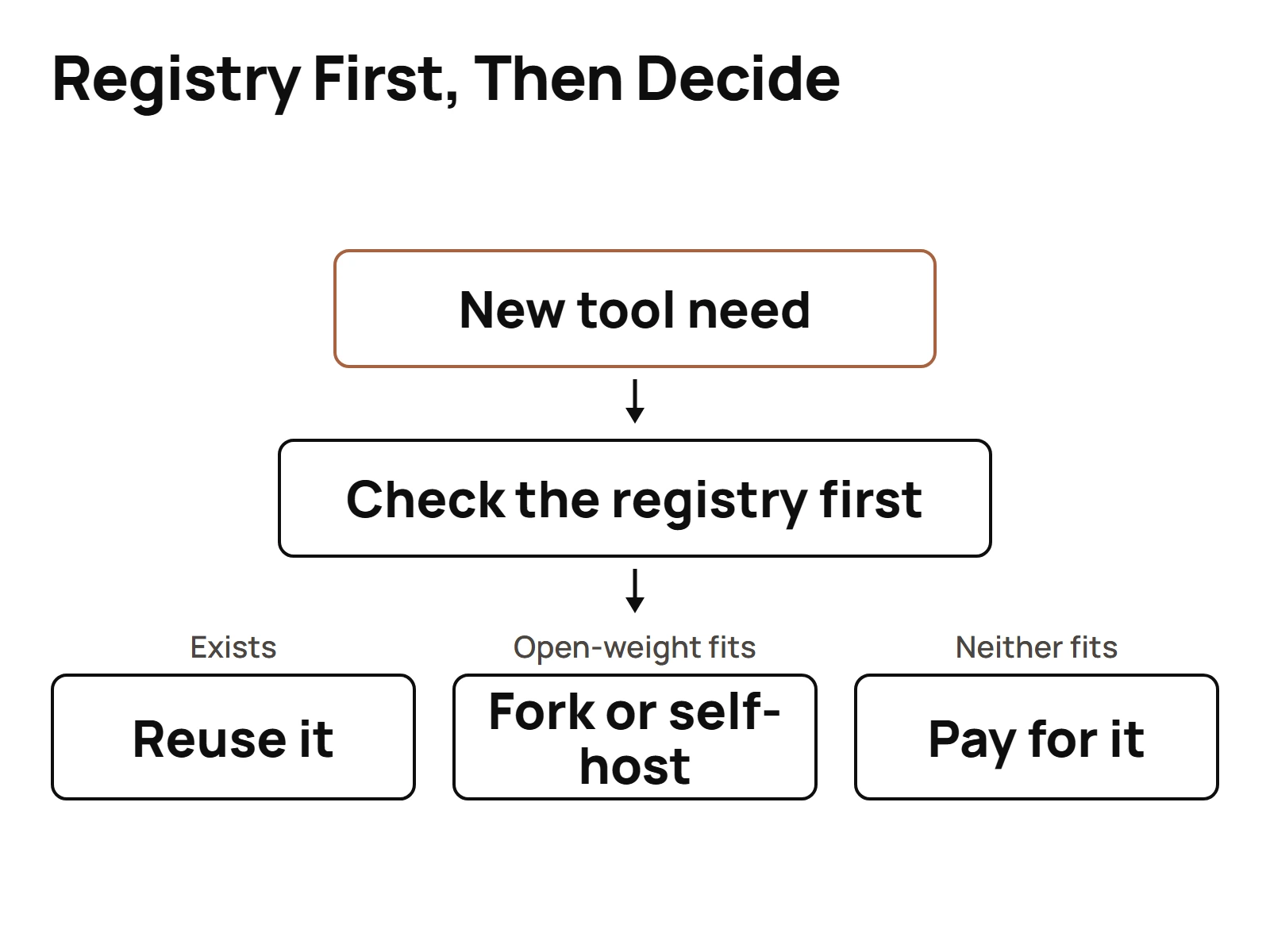
After the registry, the order goes like this:
- Do I already have it? Check the registry and the brain. At this size, skipping that step is exactly how duplicates happen.
- Is there a good open source repo? My agents evaluate before they build. A real example: my Meta ads agent flagged the "Open Generative AI" repo and came back to me with three options: clone it and eval it locally, wire it in as the creative engine for an ads dashboard, or just bookmark it. The repo actually got pulled and reviewed before anyone decided.
- Can I fork it faster than I can build it? If the core is solid and the license allows it, fork. That's how I decide build vs fork on anything bigger than a script.
- Is paying still cheaper? Sometimes yes. A tool that saves hours every week and costs less than those hours isn't a subscription problem.
And there's a spend gate on top. My own rules say no bulk LLM or API spend without my explicit GO, and one agent's whole job is cost-per-action and ROI gating before anything runs. Free tools pass that gate easily on price. They still have to pass it on time.
A lot of what I build this way ends up public. If you want to see what it looks like when I build one of these in the open, that's its own story, dashboards and all.
So here's the decision in one line. Check what you already own. Fork what's good. Build what's missing. Pay for what saves real hours. And never confuse free weights with a free system, because the bill always shows up somewhere, you know?
Questions people actually ask
- Is there a free alternative to ChatGPT?
- Yes. You can self-host an open-weight model like DeepSeek V4, run a small model locally, or pay per use through an aggregator like OpenRouter with no monthly seat. Free weights aren't free to run, though. The cost moves to hardware, setup, maintenance and your time.
- What AI is replacing ChatGPT?
- Nothing replaces it outright. People are moving from one chatbot for everything to routing jobs across several models: frontier models for hard reasoning, cheaper models for routine work, and open-weight models for bulk or private tasks. The replacement is a routing table, not a single product.
- What chatbot does Elon Musk use?
- The chatbot tied to Elon Musk is Grok, from SpaceXAI, the AI company he founded as xAI and later merged into SpaceX. As of 2026-09-23 its flagship is Grok 4.7, released September 21, 2026, with a 500K-token context window. There's no Grok 5 yet, and Grok is a paid, closed model, not an open-source alternative.
- Is there a free open source AI?
- Yes, mostly as open weights: the trained model is free to download and run, even if the training data isn't published. DeepSeek V4, released April 24, 2026 under the MIT License, can be self-hosted and used commercially with no usage tier. Check each model's license before building on it.